
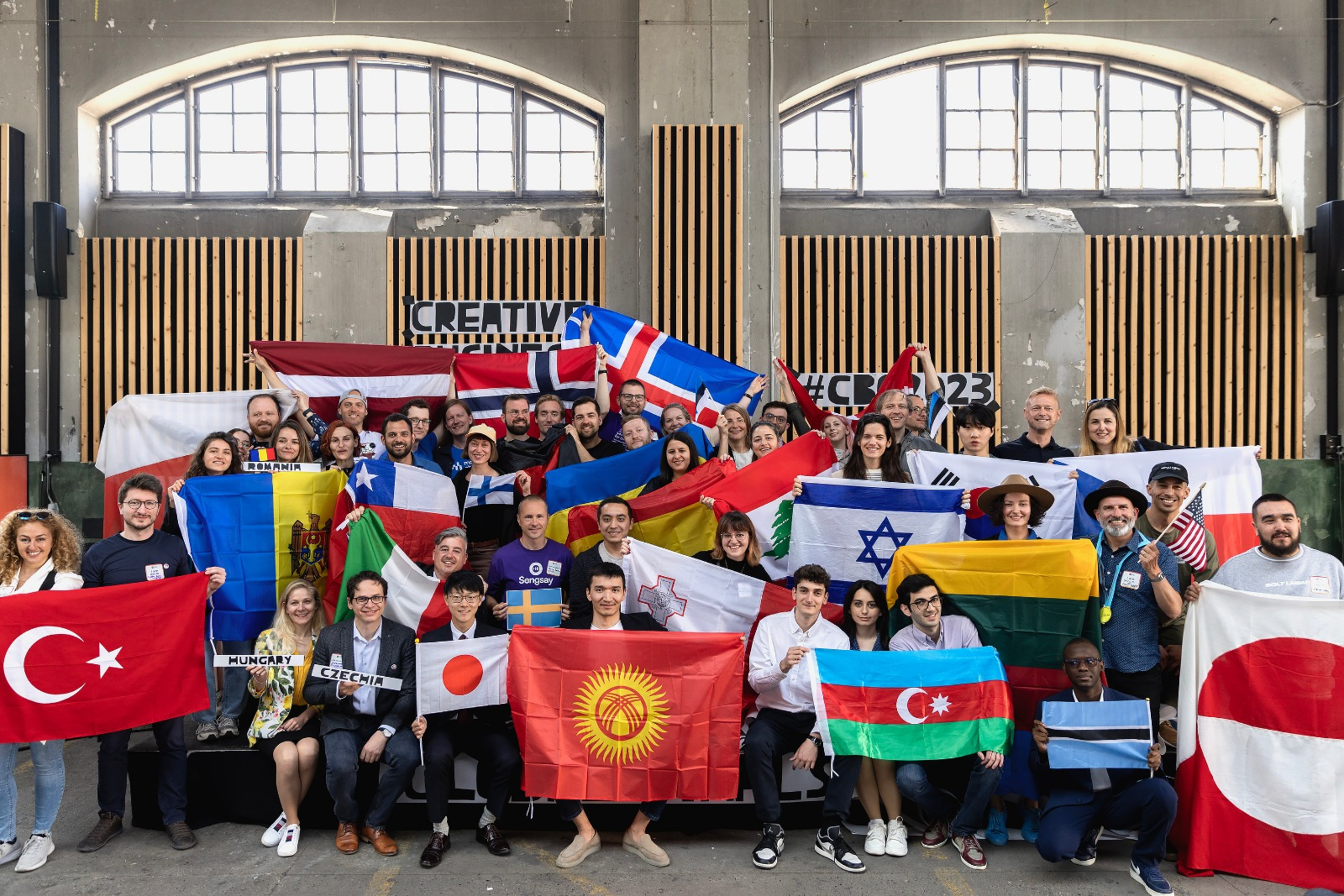
Previous years’ Creative Business Cup winners!
Creative Business Cup is an annual global competition, bringing together more than 80 countries from all around the world. Creative and innovative start-ups compete with the aim of connecting and empowering the cultural and creative industries worldwide.
The Cup has a 12-year history, with the global finals organized in Copenhagen, Denmark.
You can find more information about the competition.
Now, let’s meet the winners of Creative Business Cup:
2013 – TEDDY THE GUARDIAN, Croatia
Teddy The Guardian is a plushy bear with embedded sensors that measure child’s heart rate, blood pressure, oxygen saturation, and body temperature, and send the data using wireless technologies to parents’ smartphone. Every time a child gives Teddy a finger or puts Teddy’s paw on his forehead sensors detect the values, record them and transmit in real time to parents’ mobile app. Sensors integrated in the bear have FDA and CE approval, which means they can be sold and used around the Globe.
In order to prove the accuracy of the sensors embedded, comparative tests were performed using medical devices produced by the most prominent and well-known companies in the industry. The results were more than satisfactory showing the same data recorded.
Professor Why is a Polish company specialising in applying new and emerging technologies to develop innovative educational and entertainment solutions for both desktop and mobile. We strive to blend learning and fun in a way that energises and enthuses customers and employees. Both augmented and virtual reality play a strong part in our solutions. We help organisations striving for growth by providing their customers with entertainment that goes beyond the traditional – more engaging, fun and memorable.
This philosophy extends to forward-thinking clients, looking for effective approaches to training employees in new and interesting ways, while at the same time reducing costs. Professor Why also has education at its heart; a whole range of innovative solutions are available for schools, students and teachers who are eager to improve their skills and knowledge.
Blitab is the world’s first tactile tablet for blind and visually impaired people. Blitab is a Braille device for Braille reading and writing that displays one whole page Braille text at once, without any mechanical elements, allowing users to have an overview of a whole document. BLITAB is the first tablet that allows blind and visually impaired users to learn, work, and play with one mobile device, to have digital access to information in real-time. BLITAB converts any document into Braille text. Tixels (tactile pixels) immediately appear and disappear as the text changes.
Worldwide there are more than 285 million blind and visually impaired people, a number expected to double by 2020 (WHO, 2012). Only 1% of all published books are available in Braille, the traditional tool for literacy and education of blind people. There is a correlation of 0.9 between being a Braille user and being employed. In the developed world, over 75% of the blind and visually impaired population of working age are unemployed. For those with visual impairment, enabling print reading with Braille makes the difference between employability and educational achievement.
2016 – GREEN CITY SOLUTIONS, Germany
In their devices, called CityTrees, Green City Solutions combine the natural ability of moss to clean and cool the air with Internet of Things technology to control irrigation and ventilation. In March 2014, Green City Solutions GmbH was founded by Peter Sänger and his friend Liang Wu in Dresden. They set up a team of young experts from the fields of horticulture/biology, computer science, architecture, and mechanical engineering. The knowledge of the individuals was bundled to realise a device that combines nature and technology: the CityTree.
The living heart of CityTrees is moss cultivated on hanging textile mats. The moss mats are hidden behind wooden bars that provide sufficient shade for these plants, which naturally grow mainly in forests. Sensors are measuring various parameters such as temperature, humidity, and concentration of particulates. This data is used to regulate ventilation and irrigation. Behind the moss mats are large vents that create an airflow through the moss. In this way, the amount of air cleaned by the device can be increased when pollution levels are high, such as during rush hours.
The HEART, CELL, Functional Cell and X-Cell are the four types of cells that make up each CellRobot. Cells can be attached together by the connectors on each cells’ surfaces. To connect, simply face two cells together and gently twist.
The HEART is the brainpower of your CellRobot: The Heart supplies power to the entire robot and provides a signal connection to your smartphone or tablet. The HEART is designed as a sphere, and has 8 connectors for you to choose from on its surface.
The CELL is the basic module of CellRobot. Every CELL is a servo rotation system with an independent MCU (Microprogrammed Control Unit), which makes variable morphology possible. The two hemisphere of the BASE can do a 360 degree relative rotation, once connected to HEART, each cell can be directed to move in any direction and angle you wish. Functional Cell enables your CellRobot to become more practical. They act as add-ons to regular modules, allowing the robot to evolve and accomplish any task with the invention of these functional parts. Wheel is created for movement. It enables CellRobot to move faster. With Wheel, you are able to create your own racecar robot, scout car robot, and many more! Vision works as the eyes of CellRobot.
The eyes are created as a wide angle wireless surveillance camera that can be connected in any position. You can follow your CellRobot’s vision real time on your phone through their APP. Mount is used to connect your CellRobot to your table or your smartphone, which adds many potential uses to the robot. X-CELL is the functional module you can create by yourself. Users can turn their robots into a flying drone or even a robotic hand! The only limit is your imagination.
6Degrees’ mission is to improve people’s everyday life by enabling their digital access, and the advantages it has to offer; independence, communication, integration into society, and employability. 6Degrees' wearable AI, converting motion into digital commands allowing full control of any smart device. Modeled on the tiniest details of everyday actions—using a car media console, presenting a slide deck, swiping on a phone, controlling a joystick—6Degrees develops algorithms and devices, MyMove, that recover users’ fine motor skills output.
The startups’ latest prototype, MyMove+ accelerates virtual reality therapy for overcoming the pain caused by phantom limb syndrome. While clients seeking to recover finger motion are the primary users of the product, MyMove works just as well attached to a leg, for users without upper limb mobility. With leg use, the device captures the output of kicks, foot twists, or any other leg movements the user assigns.
Lapee is the world’s first female version of the industrialized outdoor urinals. Now, women are provided with the same ability to be safe and easy at outdoor events like men always have been. Therefore, the invention of this urinal is a success in the field of gender equality. From now on, women do not have to lose time in endless lines at outdoor events and can enjoy their time to the fullest. Nevertheless, it is not only a question of equal rights but also of hygiene and safety for women.
They no longer have to “hide behind bushes” and be ashamed of it. Behind this idea of developing safety for women are Gina Périer and Alexander Egebjerg. With LaPee, they are actively proving that it is wrong to see discrimination and ignore it. These gaps in inequality need to be highlighted and addressed through creativity and courage. Lapee is a simple solution to a long standing example of gender inequality; Lapee gives women and people who need to pee squatting a quick, safe and hygienic way out.
Lapee is pink and easy to spot. It can accommodate three users at a time. The curved walls offer privacy and protection while never feeling inclosed. The elevated position offers empowerment and makes it easy to oversee the nearby area. Lapee is a simple and sustainable choice in the sanitation industry. It is a very durable product with a long lifetime. It is made of recyclable materials and uses no water. Lapee is also stackable, in order to save carbon emissions from transportation. Lapee is touch-free and it comes with an integrated hand-sanitiser. Due to it’s open structure, Lapee is auto-ventilated and extremely easy to clean which makes it the right choice for public spaces and outdoor events.
Raiku is an Estonian startup that aims to revolutionise the innovative packaging industry. The company is focused on providing an environmentally friendly alternative to plastic bubble wrap by using wood as a replacement. The idea for Raiku came when the co-founder’s were working for a packaging company and was struck by the amount of waste generated by plastic bubble wrap. They realised that there must be a better way to protect fragile items during shipping and handling. After conducting extensive research, they discovered that wood was an ideal material for protective packaging. Not only is it a renewable resource, but it is also biodegradable & recyclable. Furthermore, wood is sturdy enough to provide effective protection for fragile items while also being lightweight and easy to handle. The company works closely with its customers to create custom solutions tailored to their specific needs.
One of the main advantages of Raiku's wooden packaging is its durability. Unlike plastic bubble wrap, which can easily tear or puncture, wooden packaging can easily ship and handled. This means that items are less likely to be damaged during transit, reducing waste and the need for costly returns and replacements.
In addition to its Eco-friendly benefits, Raiku's wooden packaging is also aesthetically pleasing. The natural wood finish provides a rustic, authentic look that is sure to impress customers. Raiku's efforts have not gone unnoticed. In 2020, the company was awarded the Creative Business Cup, a prestigious global competition that recognises innovative startups that have the potential to create positive change in the world.
Photio is a nanotechnological additive composed of a blend of nanomaterials, which can be applied in paints, asphalt, concrete, fabrics, plastics, synthetic leather, and practically any material, which upon contact with light promotes the degradation of greenhouse gases. and local pollutants. Photio is capable of degrading more than 10 different polluting gases, transforming any surface into an air purifier without modifying its appearance.
The technology has certifications and validations issued by laboratories and universities in Chile, the United States and Europe, and multiple data from industrial implementations. To date, in Chile alone, more than 85,000 m2 have been painted with Photio, and more than 40 companies have already transformed their infrastructure into enormous forests, since 1 square meter covered with Photio has the same decontaminating potential as 2 mature trees.
2022 – PLASTICPRENEUR, Austria
The Austrian social enterprise "doing circular" was founded in 2020 by Sören Lex, Florian Mikl, Raphaela Egger and Boris Rauter. Plasticpreneur develops, produces and sells simple mobile plastic recycling machines. They also provide social entrepreneurship skills that can be used to transform plastic waste into new products. This combination enables the creation of innovative products, awareness raising and the establishment of new social businesses around the world.
With their simple machines and moulds, simple recycling workshops can be set up anywhere and products made from recycled plastic. The machines can easily be shipped worldwide by parcel post and put into operation without extensive training. They provide all necessary information and support for a quick start.
Plasticpreneur is an interdisciplinary team of creative minds whose goal is to drive the transition to a circular economy. The core component of their activities is to make circular basics and principles accessible in a simple and low-threshold way.
Developed in Czechia, the NEBESYS system is a compact roof that seamlessly blends with ordinary roofs. It provides robust protection from the elements, akin to a traditional roof, while also ensuring privacy inside. The system has been rigorously tested in real-world conditions since 2011 and has proven its reliability and durability. The system employs transparent tiles, stencils, or roofing sheets to form the roofs. These elements, while indistinguishable from regular, historic ones, allow light to permeate. They are also waterproof and function as a shading element that reduces direct solar radiation by 70 to 100%. This unique feature allows the interior to bask in diffused light primarily from the brightness of the sky. In addition to its shading capabilities, the NEBESYS system also facilitates the use of under-roof spaces in urban conservation zones. This innovative approach helps reduce housing development in open landscapes, making it a sustainable choice for both urban and rural settings.
This year, Creative Business Cup 2024 is being organized on June 2nd and 3rd in Copenhagen.
Register through the events below to participate and share creativity and get the opportunity to meet start-ups from all around the world and network!
Semi-Finals, June 2nd
Link: https://mycreativenetworks.com/networks/events/144747
Global Finals, June 3rd
Link: https://mycreativenetworks.com/networks/events/140905
#CreativeBusinessCup #CBC2024 #CBCWinners