
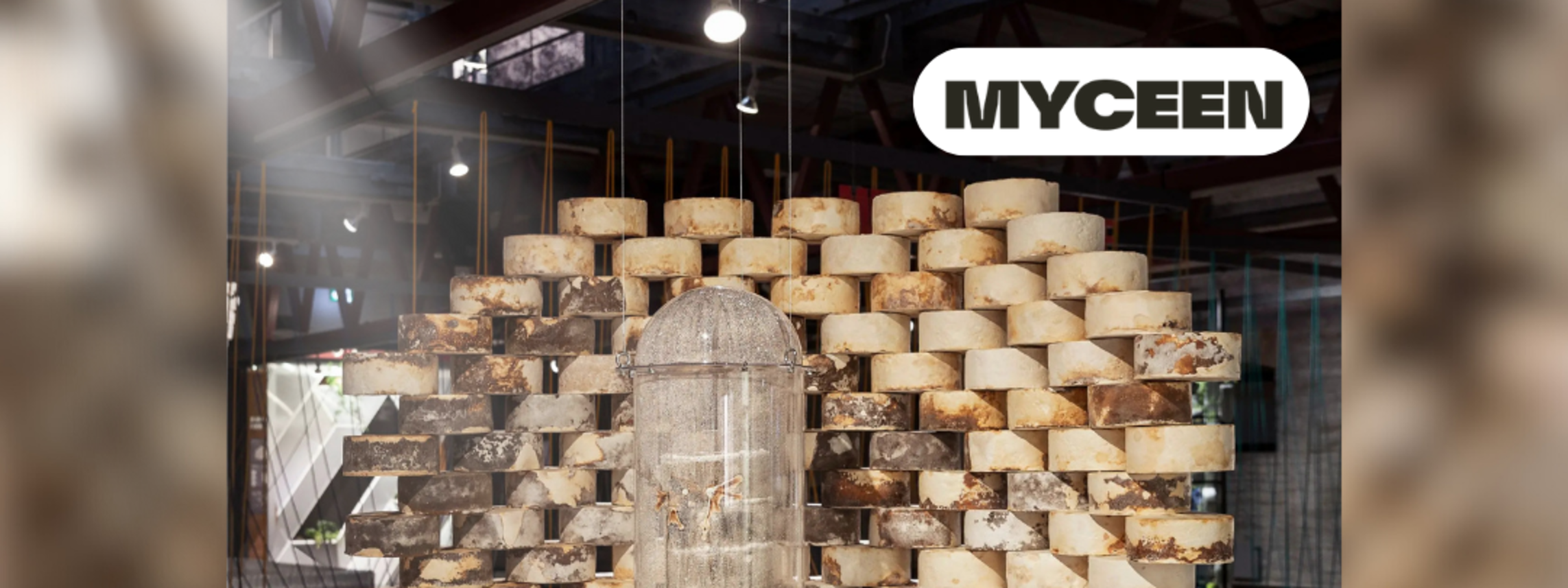
Myceen: From forest fungi to carbon-negative construction
In a world racing toward decarbonization, where architecture, art, and climate solutions rarely meet, one Estonian startup dares to ask: Can mushrooms build the future?
Founded in Tallinn, Myceen is not your average cleantech company. At its core lies mycelium — the root-like structure of fungi — which Myceen transforms into high-performance, carbon-negative materials.
From designer lamps and acoustic panels to insulation-grade building blocks, Myceen’s products are grown, not manufactured. They are biodegradable, beautiful, and born from waste.
From Design Objects to Carbon-Negative Construction
Myceen’s early creations were deceptively simple: sculptural plinths, organic lighting fixtures, and sound-absorbing wall tiles. But behind the art was deep science. The company combines agricultural and forestry waste with mycelium to create a growing medium, which — at just 25°C — produces dense, durable, and fire-resistant materials.
These products are now shipped to over 15 countries, from Singapore to the United States. As interest grew, so did Myceen’s ambition: to build sustainable structures, not just objects.
A Creative Breakthrough: Creative Business Cup
In 2022, Myceen's turning point came at the Creative Business Cup (CBC):
-
They won Creative Business Cup Estonia
-
Claimed the BRUNO Design Award, Estonia’s highest design honor
-
And at the CBC Global Finals in Copenhagen, they placed in the Top 5 worldwide
-
Most notably, they were named the event’s "Most Investable Startup"
CBC provided more than trophies — it offered global exposure, mentorship through the Creative Business Academy, and access to an investor network that valued both creativity and climate action.
A Mycelium House? Yes, Really.
In November 2024, Myceen launched its most daring project yet: the PAKK Pavilion in Tallinn, Estonia — an experimental micro-house insulated entirely with mycelium. Designed in collaboration with Pattern Building and sLender modular facades, this structure is one of the first in the world to compare mushroom-based insulation with traditional mineral wool.
The results? Striking.
-
Thermal insulation on par with standard materials
-
75% sound absorption for high frequencies
-
Fully compostable, non-toxic and mold-resistant
-
Net-negative carbon footprint
Myceen Funding Journey
To bring its vision to life, Myceen secured €2 million in public grants from:
-
Enterprise Estonia (EAS)
-
EIT Climate-KIC
-
Horizon Europe
-
Beamline Accelerator
-
The Estonian Ministry of Climate
-
SoTecIn Factory (EU program)
-
The German Ministry of Culture
In 2024, the startup launched a seed round targeting €1–1.5 million to build a pilot factory, automate production, and begin industrial-scale delivery. Investors, including the Japanese impact fund Mistletoe, took notice.
Their timing is impeccable. The EU aims to renovate 35 million buildings by 2030, and Myceen’s insulation is a certified contender in that race.
From Northern Forests to the Global Stage
Myceen has since showcased its work at:
-
The Tallinn Architecture Biennale
-
Urban Brilliance at H22 in Helsingborg
-
Exhibitions in Milan, London, and Berlin
And now, with backing from SoTecIn Factory and EU innovation programs, they’re preparing to go mainstream.
It’s a vision that began with mushrooms—and is now rooted in a global movement for change.